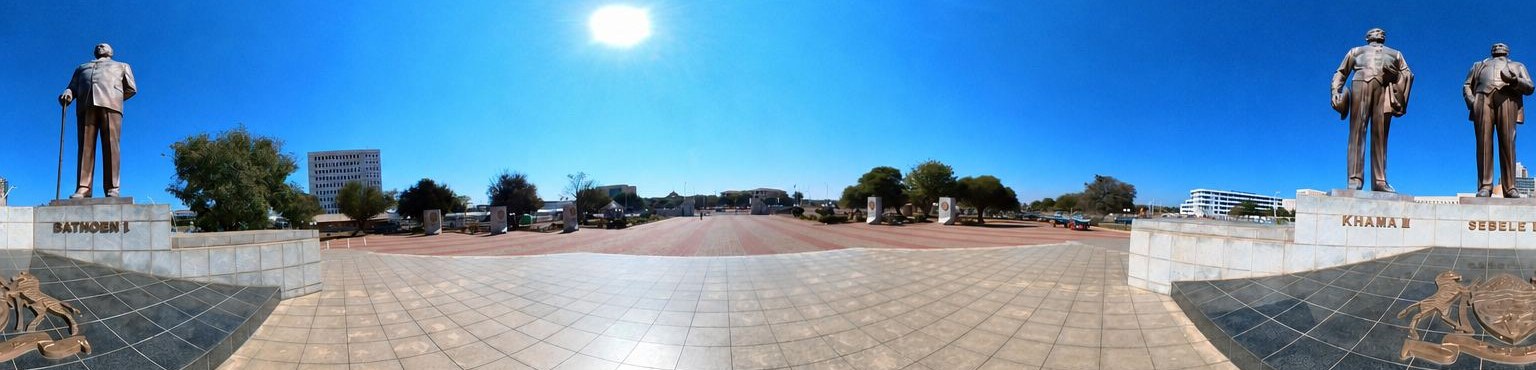
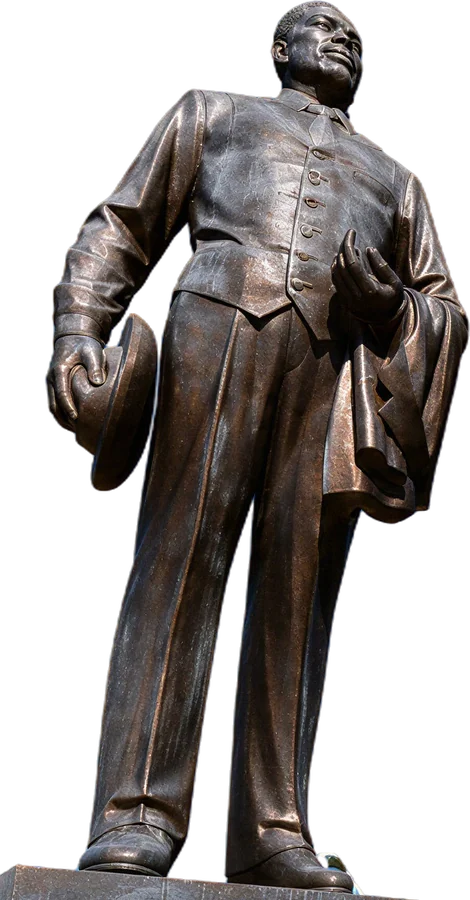
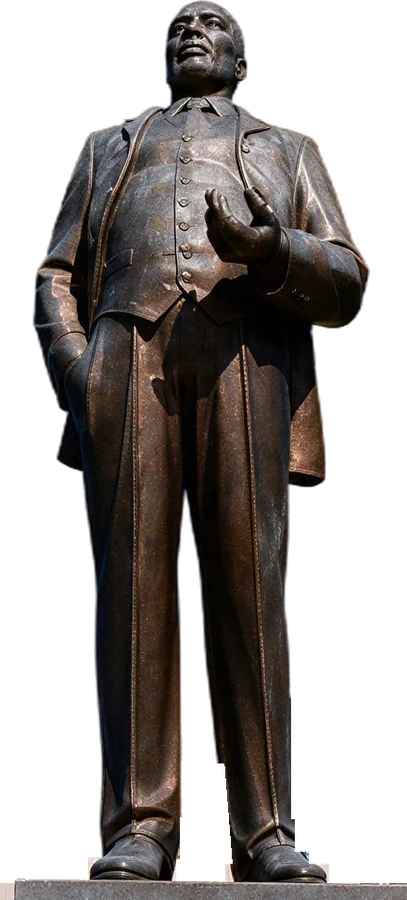
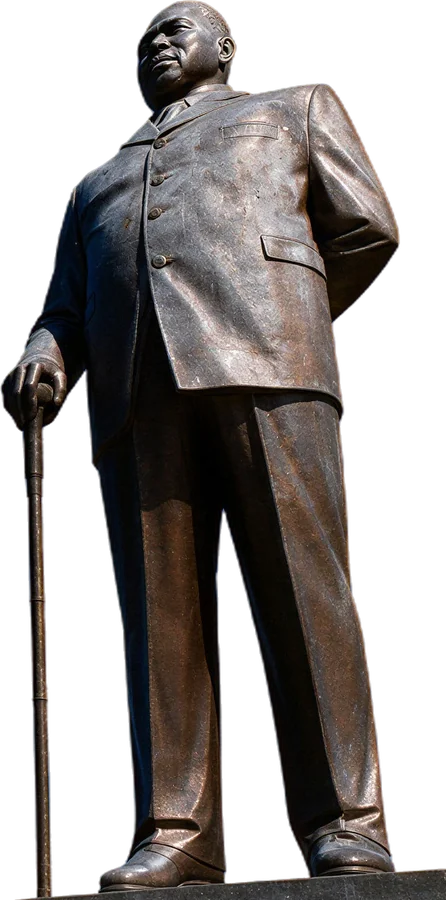
Stand at the feet of Khama III, Sebele I and Bathoen I, the chiefs who sailed to London in 1895 and kept their land out of Cecil Rhodes's hands.
Drag to look all the way round
Take the tour
Walk the monument in 360°. Look up at the dikgosi, cross the square, read each plinth.
Works on any phone or laptop. In a headset, open it full screen.
Botshabelorefuge
Bogakacourage
Boitshokoperseverance
Maikarabeloresponsibility
Boipusoindependence
Why it stands
Dikgosi is Setswana for chiefs. One chief is a kgosi.
In 1895 three Batswana chiefs travelled to Britain to stop their lands being handed to Cecil Rhodes's British South Africa Company. They won. The Bechuanaland Protectorate stayed a separate territory, and in 1966 it became the Republic of Botswana.
The bronze figures stand on a granite plinth facing the city's main civic square, with the national coat of arms set into the forecourt.
Where
Central Business District, Gaborone
Unveiled
2010
Figures
Bronze, about 5.7 m each
Cast by
Mansudae Overseas Projects
1885Britain declares the Bechuanaland Protectorate.
1895London moves to hand the Protectorate to Rhodes's British South Africa Company.
Sep 1895The three dikgosi arrive in England and tour British cities, speaking against the transfer.
6 Nov 1895Joseph Chamberlain agrees their lands stay under the Crown, not the Company.
20 Nov 1895Queen Victoria receives the three chiefs at Windsor Castle.
Dec 1895The Jameson Raid fails and disgraces Rhodes, ending the plan for good.
A strict reformer who banned the liquor trade. In Britain, church and temperance crowds packed his meetings and pressed the government to refuse Rhodes.
His grandson Sir Seretse Khama became Botswana's first president.
Sebele I
Kgosi of the Bakwena · c. 1841–1911
Reigned
1892–1911
Capital
Molepolole
In bronze
Hand raised to his chest
Son of Sechele I, David Livingstone's best-known convert. He guarded Kwena custom and independence more openly than his fellow travellers.
Molepolole is still the Bakwena capital.
Bathoen I
Kgosi of the Bangwaketse · 1845–1910
Reigned
1889–1910
Capital
Kanye
In bronze
Cane in hand, fist on hip
His lands lay right beside Rhodes's planned railway north, so he had the most to lose. A shrewd negotiator with British officials.
His grandson Bathoen II left the chieftainship in 1969 to enter national politics.
The monument in 3D
Spin the plinth, zoom in, tap a kgosi to read his story.
The three figures are 3D models generated from a photo of the real statues; the plinth and square are modelled by hand. A faithful impression, not a survey scan.